 WellPack
When Does a Commercial Energy Storage System Make Sense?
A commercial energy storage system is essentially a large-scale battery that stores electricity for later use. It connects to your facility’s electrical infrastructure and charges during periods of low energy demand or when electricity prices are low, then discharges when you need power most. Think of it as a buffer between your business and the grid—one that gives you control over when and how you use electricity.
The core technology behind most commercial energy storage systems today is lithium-ion battery chemistry, particularly LiFePO4 (lithium iron phosphate), which offers a strong balance of safety, cycle life, and performance. These systems are managed by a Battery Management System (BMS) that monitors cell health, temperature, and charge levels to ensure safe and efficient operation.
For business owners, the practical value comes down to three main applications: peak shaving (reducing demand charges by drawing from the battery during high-cost periods), load shifting (storing cheap off-peak power for use during expensive peak hours), and backup power (keeping critical operations running during outages).
The Money Question: Will It Save You More Than It Costs?
This is the question every business owner asks first, and for good reason. A commercial energy storage system is a capital investment, and you need to know when—and if—it pays back.
The single biggest financial driver for most commercial customers is demand charge reduction. Many commercial electricity bills have two components: a charge for the total kilowatt-hours (kWh) you use, and a demand charge based on your highest rate of consumption during a billing period. Demand charges can account for 30% to 70% of a commercial electric bill, depending on your utility and location. A properly sized storage system shaves those peaks, and that’s where the real savings live.
Beyond demand charges, there’s time-of-use (TOU) arbitrage. If your utility charges different rates at different times of day, you can charge your battery when rates are low and discharge when rates are high. The spread between off-peak and on-peak rates determines how much you save per kWh cycled through the system.
There are also incentives and tax benefits to consider. Federal Investment Tax Credits (ITC), state-level rebates, and utility incentive programs can significantly reduce upfront costs. These vary by region and change over time, so it’s worth checking what’s available in your area before running the numbers.
As a rough rule of thumb, most commercial energy storage systems achieve payback in 3 to 7 years, depending on your utility rates, usage patterns, and available incentives. Systems with 6,000+ cycle lives—like many modern LiFePO4 batteries—can easily last 10 to 15 years, meaning you’re looking at several years of pure savings after payback.
Is Your Facility a Good Candidate for Battery Storage?
Not every business is an ideal fit for commercial energy storage. Here are the key indicators that your facility might benefit:
You have a spiky load profile. If your energy consumption varies significantly throughout the day—with sharp peaks that drive up your demand charges—storage can smooth those peaks out. Manufacturing plants, cold storage facilities, and data centers are classic examples. If your load is relatively flat, the savings from peak shaving will be limited.
You pay high demand charges. Check your utility bill. If demand charges are a significant portion of your total cost, storage becomes more attractive. The higher your demand charge rate, the faster your payback.
You have a favorable rate structure. Utilities with wide TOU rate spreads make arbitrage more profitable. If the difference between peak and off-peak rates is at least 10 to 15 cents per kWh, storage starts to make financial sense.
You need backup power. If power outages would cost you money—through lost production, spoiled inventory, or downtime—the backup capability of a storage system adds real value beyond just bill savings.
You have solar or other on-site generation. Pairing storage with solar allows you to store excess generation for use when the sun isn’t shining, maximizing your self-consumption and reducing grid dependence.
How to Size a Commercial Energy Storage System for Your Needs
Sizing is where many businesses get stuck. Too small, and you won’t capture enough savings to justify the investment. Too large, and you’re paying for capacity you don’t need.
The process starts with your utility data. You’ll need at least 12 months of interval meter data—that’s your consumption in 15-minute or hourly increments. This data tells you your peak demand, when those peaks occur, and your total energy usage.
From there, you’re looking at two key numbers:
Power rating (kW). This is how much electricity the system can deliver at any given moment. Your system needs enough power to cover your peak demand reduction target. If your peak demand is 500 kW and you want to shave 100 kW off that peak, you need at least 100 kW of power capacity.
Energy capacity (kWh). This is how long the system can sustain that power output. If you need to shave 100 kW for two hours during peak periods, you need 200 kWh of usable capacity. A good rule of thumb is to size for 2 to 4 hours of discharge duration, which covers most commercial peak periods.
It’s worth noting that rack-mounted systems offer modular scalability, meaning you can start with a smaller configuration and add capacity as your needs grow. This flexibility is particularly valuable for businesses that are expanding or whose load profiles may change over time.
Installation, Maintenance, and What to Expect Long-Term
One of the most common concerns business owners have is about the hassle factor. How much work is it to install and maintain one of these systems?
Installation is typically straightforward for rack-mounted systems. These units are designed to be plug-and-play, with pre-assembled battery modules that fit into standard racks or cabinets. The main installation work involves electrical connections to your switchgear and integrating the system with your existing energy management setup. Most installations take a few days, not weeks.
Maintenance requirements are minimal. Modern LiFePO4-based commercial energy storage systems are largely maintenance-free. The BMS handles continuous monitoring and balancing of cells, and the system will alert you if any issues arise. There are no moving parts, no fluids to change, and no regular service intervals. Annual inspections are recommended but typically involve little more than visual checks and software updates.
Lifespan is measured in cycles, not years. A cycle is one full charge and discharge. Systems rated for 6,000 cycles at 80% depth of discharge will typically last 10 to 15 years in commercial service. Battery capacity will degrade gradually over time—most systems are designed to still have 70% to 80% of original capacity at end of life—but this degradation is predictable and can be factored into your financial model.
Safety is well-established. LiFePO4 chemistry is inherently more stable and less prone to thermal runaway than other lithium-ion variants. Combined with smart BMS protection, modern commercial storage systems are safe for indoor and outdoor installation.
Why the WellPack WPC50-01 High-Voltage Rack-Mounted Energy Storage Battery Pack Stands Out
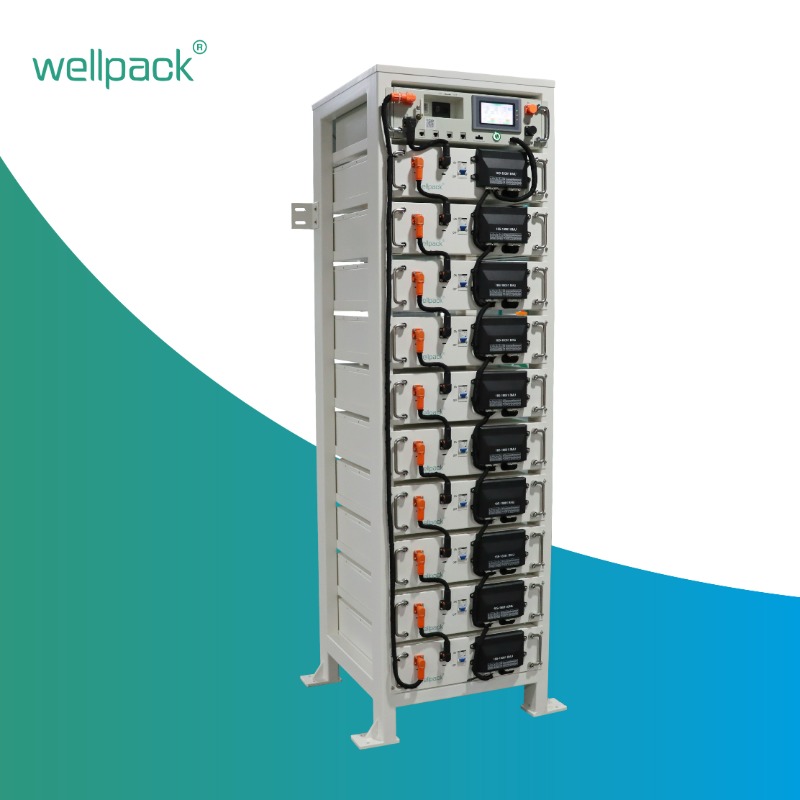
If you’re exploring commercial energy storage options, the WellPack WPC50-01 High-Voltage Rack-Mounted Energy Storage Battery Pack is worth a close look. This 51.2KWh LiFePO4 system operates at 512V nominal voltage and is designed specifically for commercial and industrial applications including data centers, telecom base stations, manufacturing facilities, and PV storage integration. It delivers over 6,000 cycles at 80% depth of discharge, meaning 10+ years of reliable service with minimal degradation. The built-in smart BMS provides comprehensive protection and monitoring, while the rack-mounted modular design makes installation simple and expansion effortless. With support for custom communication protocols and compatibility with major global inverters, the WPC50-01 integrates seamlessly into existing electrical infrastructure. It’s maintenance-free, operates across a wide temperature range, and comes in a durable sheet metal enclosure. For businesses that need a scalable, safe, and long-lasting commercial energy storage solution, the WellPack WPC50-01 delivers strong value and reliable performance.