 WellPack
What Affects the Lifespan of a Start-Stop Battery?
What Determines How Long a Start-Stop Battery Lasts
If your vehicle has stop-start technology, the battery works harder than a conventional car battery. Every red light, every traffic jam, every parking lot pause triggers the engine to shut off and restart, and each restart draws a burst of current. A typical start-stop battery can go through tens of thousands of engine cycles over its service life, compared to a few thousand for a standard battery in a non-stop-start car. That workload is the single biggest factor behind how long a start-stop battery actually lasts.
Battery chemistry plays a major role too. AGM (absorbent glass mat) batteries were the standard choice for years because they tolerate frequent cycling better than flooded lead-acid units. More recently, lithium iron phosphate (LiFePO4) batteries have entered this space, offering a longer cycle life and steadier performance under the same demanding conditions. Beyond chemistry, driving style, climate, and charging habits all combine to either stretch out or shorten a start-stop battery’s working life.
Signs Your Start-Stop Battery Is Wearing Out
A failing start-stop battery rarely dies without warning. One of the earliest signs is that the stop-start system simply stops engaging, or engages less often. Most vehicles are programmed to disable the feature automatically when the battery’s state of charge drops too low, since the car needs enough reserve power to guarantee a reliable restart. If you notice the engine no longer switches off at stops the way it used to, that’s often the battery management system quietly protecting itself.
Other symptoms include a slower crank when starting the engine, dashboard warning lights related to the battery or charging system, and accessories like the radio or interior lights dimming briefly during a restart. None of these issues are dramatic on their own, but together they usually point to a battery that’s nearing the end of its lifespan and should be tested or replaced before it fails completely.
Temperature and Its Effect on Battery Life
Heat is one of the fastest ways to age any battery, start-stop or otherwise. High under-hood temperatures speed up internal chemical reactions, which accelerates plate corrosion in lead-acid designs and gradually reduces capacity. Parking in direct sun, short trips in hot climates, and engine bays that run consistently warm all shave time off a battery’s useful life.
Cold weather brings a different problem. Low temperatures slow down the chemical reactions a battery needs to deliver power, so cranking amps drop right when the engine needs the most energy to start. This is particularly hard on lithium-based batteries without built-in heating, since lithium cells can lose significant output capability in freezing conditions. A battery that has to fight through repeated cold starts and hot-climate stress in the same year will typically show wear faster than one used in a mild, stable climate.
Charging Habits That Extend or Shorten Lifespan
How a battery is charged day to day matters just as much as how it’s used. Short commutes that never let the alternator fully replenish the battery leave it in a partial state of charge for long stretches, and that condition is one of the most common causes of premature failure. A start-stop battery that regularly sits below full charge builds up internal resistance over time, which reduces both its capacity and its ability to handle rapid cycling.
Leaving accessories running with the engine off, letting a vehicle sit unused for weeks, or using a charger that isn’t matched to the battery’s chemistry can all cause similar problems. For lead-acid start-stop batteries, an occasional full charge from a compatible maintainer helps offset the effects of stop-and-go driving. Lithium batteries handle partial charging far better and don’t suffer the same sulfation issues, which is a large part of why their lifespan tends to hold up better under real-world driving patterns.
Lithium vs AGM Start-Stop Batteries
AGM batteries have long been the default upgrade for stop-start vehicles because they resist vibration and handle moderate cycling better than flooded batteries. Even so, AGM batteries generally rate for somewhere around 500 to 800 charge cycles before capacity noticeably declines, and their performance still drops off in extreme heat or cold.
Lithium iron phosphate batteries change that equation. LiFePO4 cells commonly deliver 4,000 or more charge cycles, resist the capacity fade that comes from partial charging, and weigh considerably less than an AGM unit of equivalent capacity. That combination of a longer cycle life, lighter weight, and steadier output under repeated starts is why more vehicle owners and fleet operators are switching their start-stop setup over to lithium once their original battery reaches the end of its service life.
Choosing a Longer-Lasting Start-Stop Battery
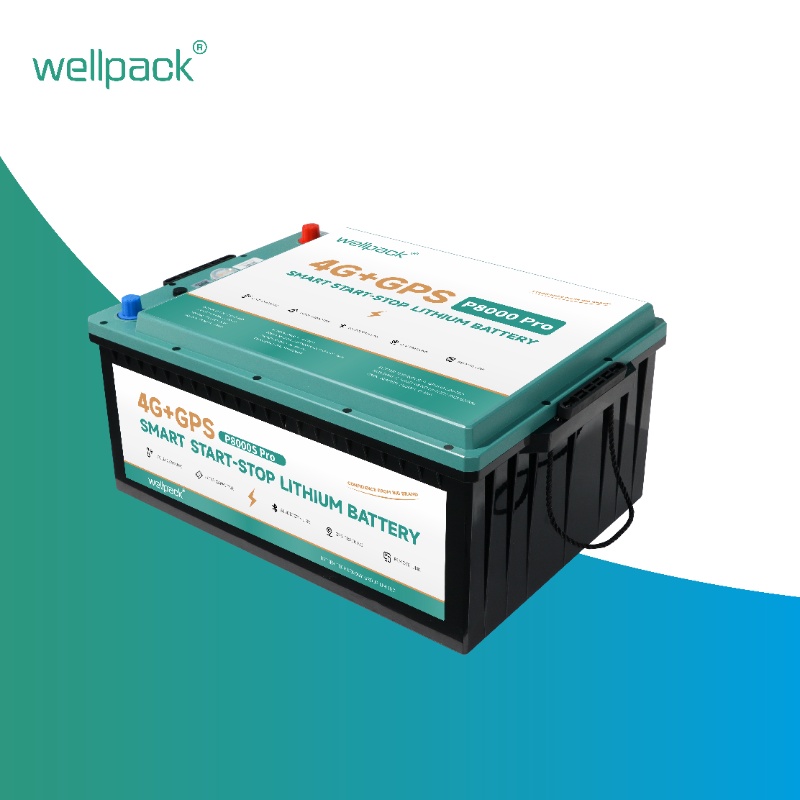
If your current start-stop battery is showing the warning signs above, or you simply want a battery built to handle frequent cycling without losing performance in hot or cold weather, the 4G+GPS Smart Start-Stop Lithium Battery P8000 Pro from WellPack is worth a look. It’s built with Grade A LiFePO4 cells and rated for 4,000+ life cycles, giving it a meaningfully longer lifespan than a typical AGM replacement. An intelligent BMS provides eight layers of protection against over-charge, over-discharge, short circuit, and extreme temperatures, while a built-in heating function keeps the battery working normally even in freezing conditions that would otherwise limit output. Bluetooth and a 4G module let you monitor charge status and control the battery remotely, and a waterproof, IP65-rated case adds durability for trucks and vehicles that see rough conditions. For anyone looking to replace an aging start-stop battery with one built to last, it’s a solid, well-protected option.