 WellPack
Floor-Standing vs Wall-Mounted LFP: Which Saves Space?
Most buyers start the home energy storage search thinking they need to pick a form factor first. In reality, the wrong choice quietly drains money: wall-mounted units can hit capacity ceilings that force you to buy a second tower, while floor-standing units can eat floor area you later wish you had for something else. This article cuts through the marketing and shows you how to match a floor-standing LFP battery or a wall-mounted unit to your space, load, and budget — so you can request a quote with confidence instead of guessing.
Space Saving Starts With Your Floor Plan
The most obvious difference between a floor-standing LFP battery and a wall-mounted LFP battery is where the volume goes. Wall-mounted units trade floor space for wall load — you need a load-bearing wall capable of holding 50–150 kg, and you lose that wall section for shelving or décor. Floor-standing units occupy 2–5 m² of floor area depending on capacity, but they ask nothing of your walls.
Here is the practical split:
- Studios, apartments, and garages with limited floor area → wall-mounted wins on space saving. A 10 kWh wall unit typically measures around 600 × 800 × 200 mm.
- Homes with a utility room, basement, or corner that is otherwise dead space → a floor-standing LFP battery turns that unused footprint into 15–30 kWh of storage without any wall modification.
- Retrofit projects where wall structure is uncertain → floor-standing avoids the €800–1,200 wall reinforcement cost that wall-mounted installs often require in older buildings.
One nuance buyers miss: “space saving” is not just about square metres. A wall-mounted unit that forces you to install two of them to hit your target capacity may ultimately occupy more wall length than a single slim floor-standing tower occupies in width. Measure both axes before you decide.
Capacity Ceiling: Where Wall-Mounted Hits the Wall
Wall-mounted LFP systems typically cap out at 30 kWh per setup. Floor-standing LFP battery cabinets routinely support 50–100 kWh, and many support parallel expansion to go further. This matters because battery sizing is the single biggest driver of both cost and satisfaction.
Use this quick matching table:
| Your Home / Load | Recommended Capacity | Form Factor Fit |
| Studio, essentials only, 12–24 hr backup | 5–10 kWh | Wall-mounted |
| 2–3 bedroom home, essentials + one AC zone | 10–20 kWh | Either — floor-standing scales cheaper |
| 3–4 bedroom home, whole-home backup | 20–30 kWh | Floor-standing LFP battery |
| Off-grid or multi-day autonomy | 30–100 kWh | Floor-standing, parallel |
The takeaway: if you need more than 10 kWh, the floor-standing LFP battery almost always wins on cost per usable kWh. Adding a second wall-mounted unit costs more per kWh than expanding a floor-standing cabinet.
Installation Cost and Labor: The Hidden Line Item
Buyers often compare sticker prices and ignore installation. Wall-mounted units need structural assessment, bracket mounting, and often cable routing through walls. Labor runs 200–500. Floor-standing units skip the wall prep, cutting installation labor to 100–200 with 1–3 hours on site.
Reinforced flooring is another hidden cost. Floor-standing units concentrate 90–130 kg on a small floor patch. In most modern homes this is fine; in older buildings with weak joists, you may need to reinforce — but this is typically cheaper than reinforcing a wall to carry the same weight.
Lifecycle Cost Beats Upfront Price
A LiFePO4 battery costs 20–40% more upfront than lead-acid, but delivers 3,000–6,000 cycles at 80% depth of discharge — translating to 8–15 years of daily use. When you calculate cost per delivered kWh over the battery’s lifetime, LFP is dramatically cheaper than any alternative.
What actually moves the lifetime number:
- Depth of discharge — prioritize ≥80% DoD to maximize usable energy.
- Cycle life — target 4,000+ cycles; anything under 3,000 will cost you in replacements.
- BMS quality — cell-level balancing, temperature cutoffs, and short-circuit protection are non-negotiable. A quality BMS is the difference between a 10-year battery and a 5-year one.
- Round-trip efficiency — LFP runs 95–98%, meaning almost no energy is lost in the charge/discharge cycle.
When you evaluate a floor-standing LFP battery quotation, divide the total installed price by (usable kWh × expected cycles). That number — cost per delivered kWh — is your true comparison metric, not the sticker.
Safety and BMS: Non-Negotiable for Indoor Placement
LiFePO4 chemistry is inherently safe — it resists thermal runaway above 270°C, versus 150–200°C for NMC. But “safe chemistry” is not the same as “safe installation.” Your BMS must provide overcharge, over-discharge, over-current, short-circuit, under-voltage, over-voltage, high-temperature, and low-temperature protection. Eight layers, minimum.
Also verify certifications: UL1973, UL9540, UN38.3, and IEC62619 are the marks that matter for residential insurance and code compliance. If a supplier cannot produce these, walk away — grey-market “Grade B” cells sold as Grade A are common and will fail you in year three.
Communication protocols matter for future expansion. RS485 and CAN are the mainstream standards that let your battery talk to hybrid inverters from Victron, SMA, Growatt, Deye, and others. Without them, you are locked into a single inverter brand.
Modular Expansion: Plan for Year Three, Not Just Today
Your energy demand will grow. EV charging, a heat pump, a home office, an extension — all push your daily kWh upward. A floor-standing LFP battery with modular, plug-and-play expansion lets you add capacity without rewiring or replacing your first unit. Wall-mounted systems rarely offer this gracefully; you typically bolt on a whole second unit.
Why Wellpack WPH16F-01 Deserves a Place on Your Shortlist
Wellpack’s WPH16F-01 floor-standing LFP battery hits the sweet spot for 3–4 bedroom homes and small commercial backups. Its 51.2V 314Ah configuration delivers 16.08 kWh in a single 660 × 250 × 685 mm cabinet weighing 123 kg — meaning you get the capacity ceiling of a floor-standing design without sacrificing excessive floor area. The built-in smart BMS provides the eight-layer protection profile outlined above, and dual RS485 ports enable seamless integration with your existing monitoring or inverter system. A high-definition display plus mobile APP control gives you real-time visibility into pack voltage, current, temperature, and SOC.
Key advantages that align with everything discussed in this article:
- True space saving for high capacity — 16.08 kWh from a single slim tower, expandable in parallel for off-grid or whole-home backup.
- Grade-A LiFePO4 cells with ≥6,000 cycle life, delivering 8–10+ years of daily cycling.
- 200A max charge/discharge current, enough to start a 3-ton central AC or run a well pump without tripping.
- Eight-layer BMS protection covering every failure mode that matters for indoor residential placement.
- Flexible inverter pairing — works with hybrid inverters for backup, off-grid, or self-consumption modes.
- Plug-and-play modular architecture — add modules as your demand grows, no complex rewiring.
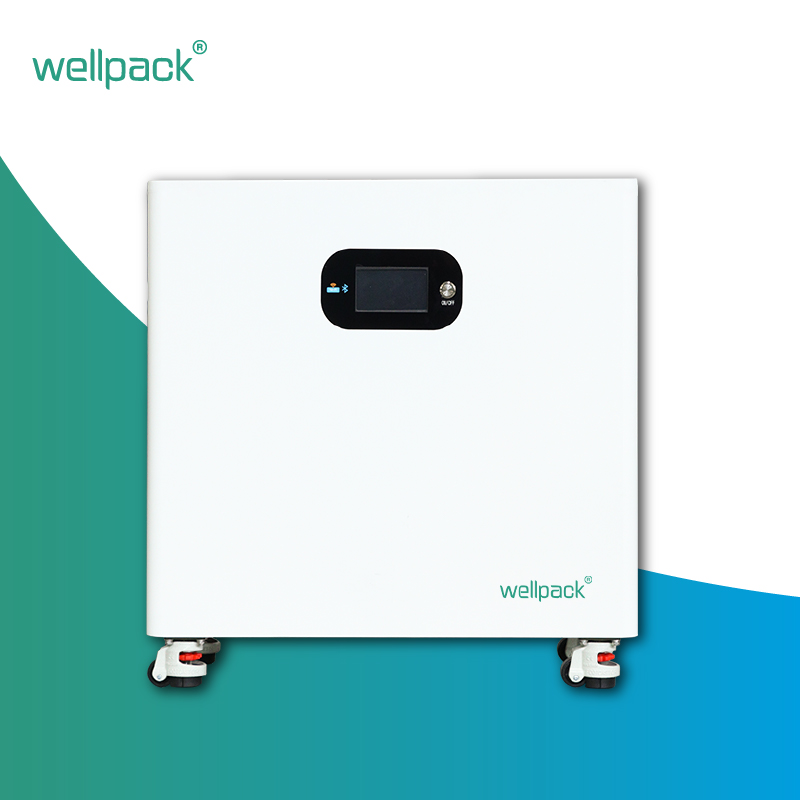
If your daily consumption sits between 10–20 kWh and you have even a small utility room, garage corner, or basement nook, the WPH16F-01 floor-standing LFP battery will likely deliver a lower cost per usable kWh than any wall-mounted competitor while leaving your walls untouched. Contact Wellpack for a tailored quotation — share your daily kWh, backup goals, and available floor space, and their engineering team will size the right parallel configuration for your home.