 WellPack
Home Backup Power: Keep Your House Powered During Outages
Power cuts do not announce themselves. One moment the lights, fridge, Wi-Fi, and home office router are running; the next, your family is left in the dark, your refrigeration is ticking against the clock, and your remote-work laptop is draining fast. Whether you are dealing with aging grid infrastructure, storm seasons, or rising time-of-use electricity rates, a properly planned home backup power setup is no longer a luxury — it is a practical shield for your daily life and finances. This article walks you through how to size a residential battery system, how to balance backup protection with monthly bill savings, and what to look for before requesting a quote.
Why Households Are Switching To Home Battery Backup
According to the U.S. Energy Information Administration, the average American household experienced more than 7 hours of power interruptions in 2022, and that number keeps climbing as extreme weather and grid stress increase. At the same time, utilities in many regions have rolled out time-of-use (TOU) tariffs where evening peak rates run 3–5× higher than off-peak hours.
A modern home battery backup system answers both problems at once. It stores energy from solar panels or cheap off-peak grid power, then quietly powers your essentials during an outage or discharges during expensive peak windows. Unlike gas generators, it runs silently, emits no fumes, and requires no manual refueling at 2 a.m. during a storm.
Backup Power Vs. Bill Savings: Which Strategy Fits You
Before comparing products, you need to decide what your battery is mainly for. The two dominant strategies have very different implications for sizing, cycling, and ROI:
| Strategy | Primary Goal | Battery Usage Pattern | Battery Life Impact | Best For |
| Backup Power | Energy reliability during blackouts | Only during outages | Longer (fewer cycles) | Homes with frequent blackouts, medical devices, or unstable grids |
| Bill Savings | Cost optimization via load shifting | Daily charge/discharge cycles | Slightly shorter (more frequent cycles) | Regions with high or variable electricity rates, TOU tariffs |
Neither approach is universally “better” — the right answer depends on your local electricity rate structure, your solar array size, and how often your area actually loses power. Many homeowners land somewhere in the middle: reserve a portion of capacity exclusively for outages, and let the rest cycle daily for bill savings.
How To Size Your Residential Solar Energy Storage System
Sizing is the single most important — and most overlooked — step. A system that is too small leaves your fridge offline; one that is too large wastes capital. Use the following reference points:
- 5–10 kWh: Covers essential circuits — refrigerator, lights, Wi-Fi router, phone charging, security system — for roughly 12–24 hours.
- 10–15 kWh: Powers essentials plus limited HVAC or well pump operation, extending coverage to a full day or more.
- 20–30 kWh: Runs most of the home including short HVAC cycles, suitable for longer outage windows.
- 40 kWh and above: Whole-home backup with multi-day coverage and EV charging support.
To calculate your own requirement, list every appliance you want to keep running, note its running watts (a refrigerator is typically around 700 W, a microwave about 1,000 W, a Wi-Fi router only 20 W), and multiply by the number of hours you expect to run on battery. The result is your minimum kWh capacity.
For backup power for home office scenarios, pay special attention to starting surges. Laser printers, desktop workstations, and networking gear can draw temporary spikes that exceed their rated running wattage. A battery system with a pure sine wave inverter and adequate surge capacity avoids the dips and “dirty power” that traditional gas generators often produce.
Maximizing Solar Self-Consumption And Cutting Monthly Bills
Without storage, a typical solar home directly consumes only about 30%–40% of the energy it generates. The rest is exported to the grid, often for a very low buyback credit. Adding a residential solar energy storage system changes that math dramatically:
- Your solar self-consumption rate can rise to 60%–80%, sometimes higher.
- In regions with TOU pricing, daily load shifting can save a typical household between 600 and 2,000 per year.
- With dynamic tariffs and a smart meter, the battery can charge when grid power is cheapest and discharge when prices spike — without any manual intervention.
The key is automated, intelligent energy management. A system that simply stores solar and dumps it back to the grid at a bad rate is leaving money on the table. Look for platforms that support scheduled charging, TOU automation, and real-time app monitoring so you can see exactly where every kilowatt-hour goes.
What To Look For Before You Request A Quote
Not all home backup power systems are created equal. When evaluating suppliers, these five criteria separate a dependable system from a regrettable purchase:
1. Battery chemistry. Lithium iron phosphate (LiFePO₄) cells are the current standard for residential storage, offering 3,000–5,000 charge cycles, which translates to roughly 8–10+ years of daily use. They are safer and longer-lasting than older chemistries and perform well in a wide temperature range.
2. Inverter waveform and power rating. Insist on a pure sine wave output. Cheap modified sine wave inverters can damage sensitive electronics and cause audible buzzing in fans and pumps.
3. Smart BMS and multi-protocol communication. A built-in Battery Management System should provide automatic protection against over-charge, over-discharge, and overheating. Support for mainstream communication protocols (CAN, RS485, etc.) ensures the system works with most solar inverters and home automation setups.
4. Installation complexity. Traditional whole-home systems often require licensed electricians, permits, and structural modifications. A plug-and-play, all-in-one unit eliminates those costs and shortens deployment from weeks to an afternoon.
5. Monitoring and control. On-unit displays plus remote app control let you track voltage, current, power, and temperature in real time, switch modes remotely, and receive alerts — turning a passive battery into an active energy management tool.
| Feature | Why It Matters |
| LiFePO₄ cells | 3,000–5,000 cycles; 8–10+ years of service life |
| Pure sine wave inverter | Safe for sensitive electronics and appliances |
| Smart BMS | Automatic protection, longer battery lifespan |
| Plug-and-play design | No electrician or permit — lower total cost |
| App + display monitoring | Real-time control and energy visibility |
Why Wellpack’s 5.12kWh Residential Solar Energy Storage Solution Stands Out
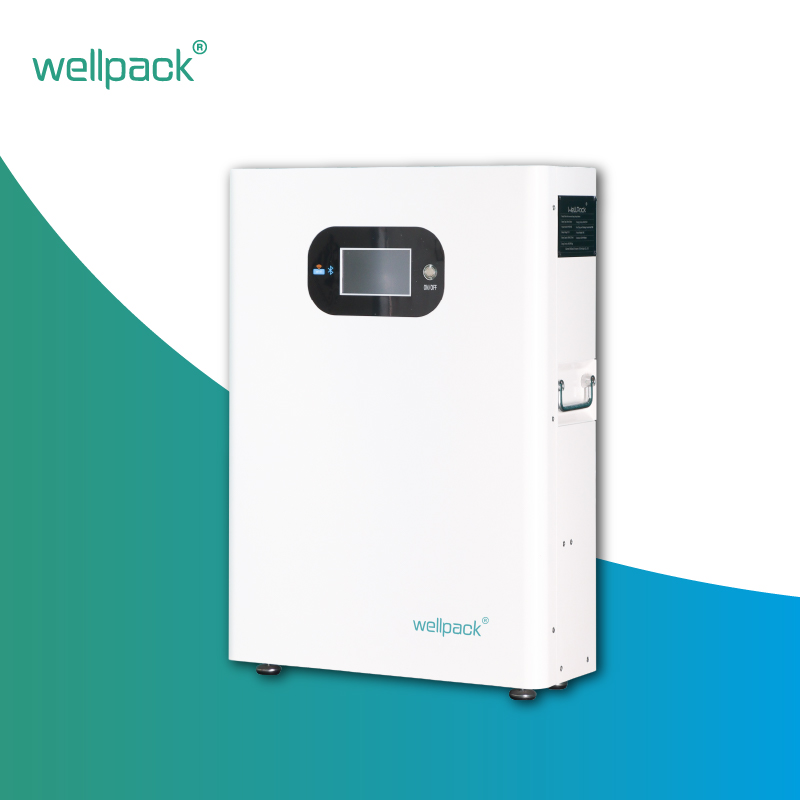
If you are looking for a system that ticks every box above without the headaches of traditional installation, the Wellpack 5.12kWh Residential Solar Energy Storage Solution deserves a serious look. It is a true all-in-one, plug-and-play system that combines a 5 kW off-grid inverter (pure sine wave), a 5.12 kWh LiFePO₄ battery (51.2 V / 100 Ah), and three 590 W photovoltaic panels in a single package — ready to deliver reliable home backup power with seamless off-grid capability.
Key advantages that matter to buyers:
- No electrician needed. The plug-and-play design rolls into place and connects without permits, saving meaningful installation cost.
- All-in-one footprint. No external components, no wall-mounted enclosures — compact enough for a garage, utility room, or home office.
- Safe, long-life LiFePO₄ technology. Environmentally friendly chemistry with 3,000–5,000 cycles, translating to 8–10+ years of daily use.
- Smart BMS with multi-protocol communication. Automatic protection with CAN, RS485, and other mainstream protocols — compatible with most solar inverters and home automation systems.
- Dual monitoring. An on-unit display plus a free mobile app (no subscription) give you full visibility and remote control of on/off and mode switching.
- Automatic outage response. When the grid drops, the system seamlessly switches to backup mode, keeping your connected appliances running.
- Solar-ready. With up to 7,500 W maximum PV input and MPPT working voltage of 125–425 V, the system captures daytime solar surplus for use at night or during blackouts.
- Portable design. Swivel wheels let you move power where it is needed — home, office, or even a campsite.
Delivery typically runs 15–45 days. For households whose needs grow over time, modular expansion options may be available depending on the chosen configuration — contact Wellpack directly to confirm the right path for your load profile.
If your goal is to protect critical loads during the next blackout while quietly chipping away at your monthly electricity bill, this system offers a balanced, cost-effective entry point into residential energy storage. Request a free consultation or a tailored quote from Wellpack to map the solution to your home’s exact consumption pattern — it is the fastest way to move from research to a powered, resilient home.